CARA
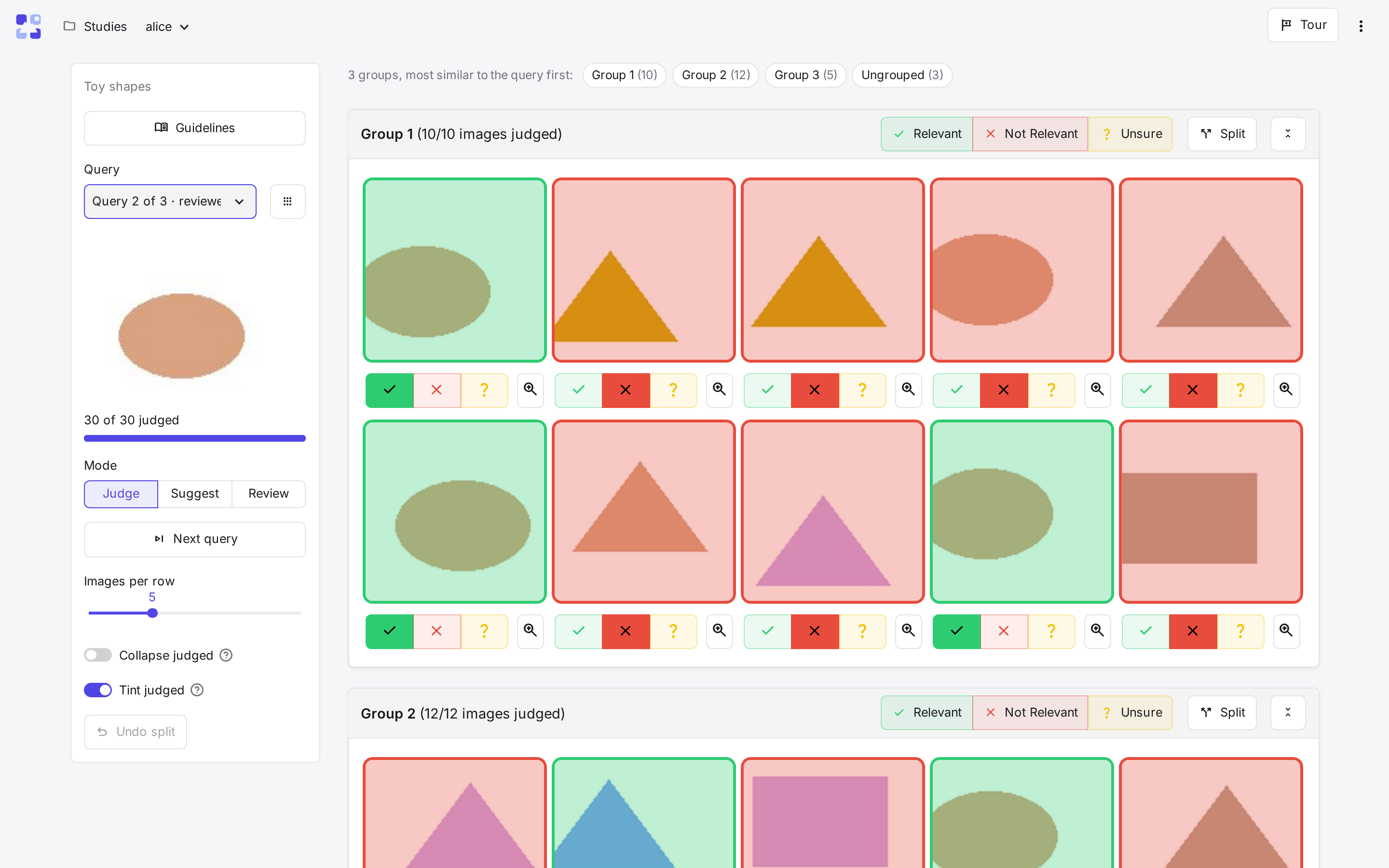
Cluster-Assisted Relevance Assessment for image retrieval. CARA is a web tool for judging every image in the pool retrieved for a query, so that each one ends up with a relevance label. It groups the pool's images by visual similarity: an annotator labels a whole group with one click and corrects single images where needed. Queries can be an image, a text, or both (composed retrieval), and the output is TREC qrels.
Features
- Group, then correct. Groups of similar images, most similar to the query first. A mixed group splits in two, and a group label never overwrites an image labelled on its own.
- Candidate sampling. The candidates of existing runs, the nearest neighbours of one or more encoders (TREC-style depth pooling), or a random sample as a baseline.
- Pilot, simulate, then annotate. A pilot shows how people judge. The settings simulator then replays your queries under each grouping and shows what it costs in time and recall.
- Guidelines with real examples. What counts as relevant, illustrated with the images pilot annotators disagreed on.
- Several annotators. Fair, shuffled queues, progress per person, Cohen's κ and Krippendorff's α, and adjudicators for the final labels.
- Exports. TREC qrels per annotator and by consensus, training pairs with hard negatives, and the full action log for effort studies.
Where to start
| You want to | Read |
|---|---|
| try CARA on your machine | Installation, then the tutorial |
| try it on museum images | A study on The Met |
| judge your own collection | Datasets, then Run a study |
| host it for a team | Deployment |
| judge images in a study you were added to | Judging |
| add an encoder or a grouping method | Extending CARA |
| reproduce the paper | Reproducing the paper |
Citation and licence
CARA is released under the MIT licence. To cite it, use the citation file, which GitHub shows as Cite this repository. Each release is archived on Zenodo.